Further Development of the Dispatch System
UX/UI Design & System Optimization
A multifaceted role in a complex large-scale project
Context & Domain
Client project in the Homeland Security Sector
Role
UX/UI Designerin & PMO Support
Timeframe
April 2024 – December 2024
Methods used
- Heuristic Evaluation
- Documentation
- UI Design
- Quality Assurance
- Prototyping
Tools used
- Figma
- Confluence
- Jira
- MS Office
Team Constellation
- 1 UX Designerin
- Team Business Analysts
- Team Dev
An emergency dispatch system for fire and rescue services is specialized software that receives emergency calls, dispatches personnel, and coordinates emergency responders and resources in real time. It serves as the operational backbone of critical infrastructure and must meet the highest standards of reliability, usability, and technical precision.
The Project Context
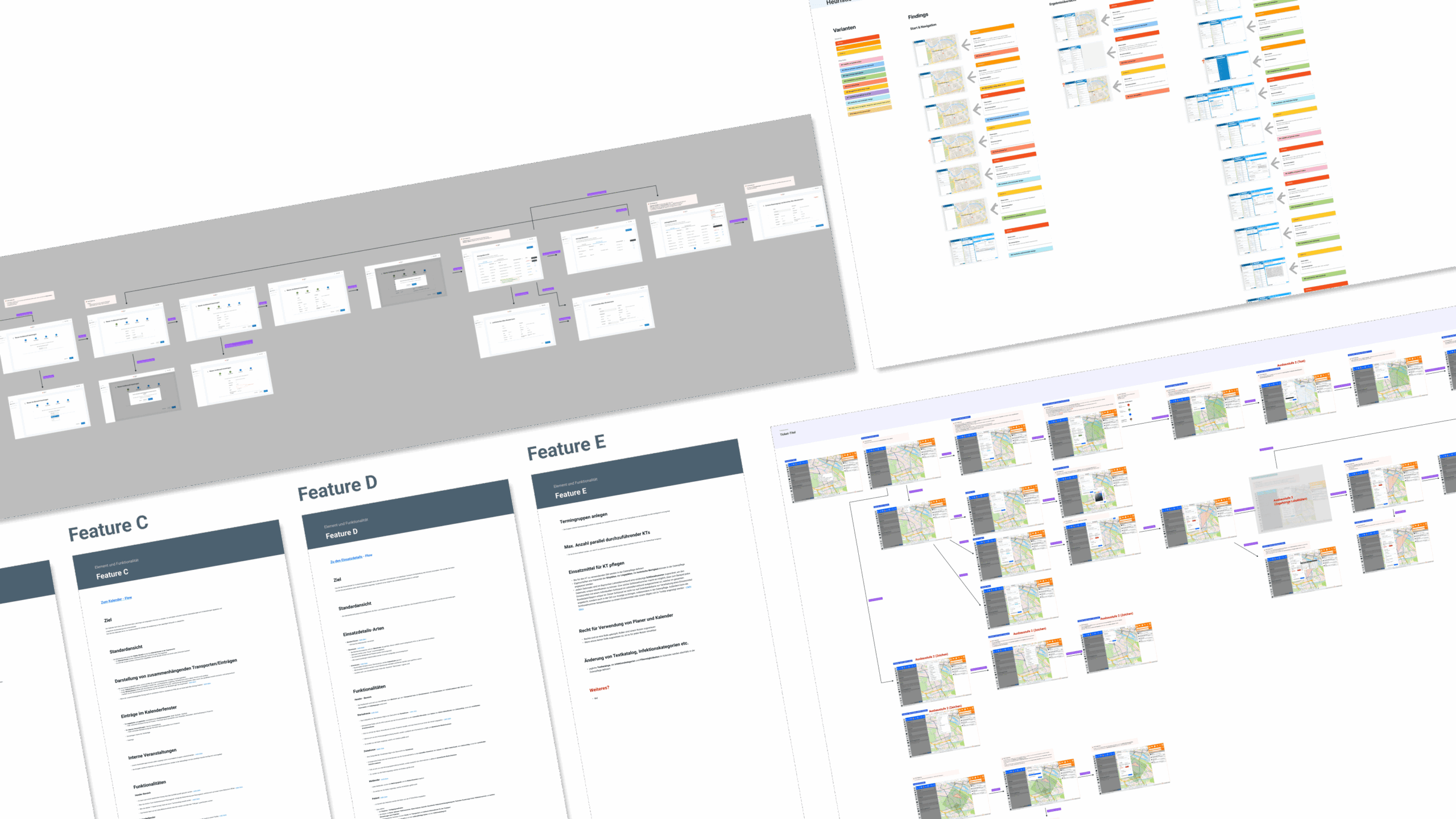
- Large-scale projects in this context rarely follow a linear path. Requirements arise based on the situation, priorities shift, and multiple workstreams run in parallel.UX work here does not follow a traditional end-to-end process, but rather takes place wherever it creates the greatest value at any given moment.
- In this project, I therefore took on a flexible, needs-based role that went beyond clearly defined responsibilities. Instead of focusing on a single feature, I was responsible for several targeted contributions across different project phases—from analysis and design to documentation and quality assurance, all the way through to proof-of-concepts.
- The focus was on the targeted improvement of existing structures, the design of individual feature enhancements, and supporting the project through methodological, conceptual, and operational UX work. The following sections highlight these contributions and place them in their respective contexts.
Analysis & Quality Assurance
Heuristic Evaluation
Assessment
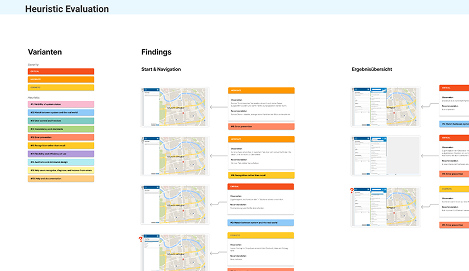
As the first step in a systematic assessment, a heuristic evaluation was conducted. The goal was to establish a sound basis for decision-making regarding future modernizations and redesigns. Even though the planned comprehensive redesigns were not implemented immediately due to project-related reasons, the analysis provided valuable documentation of the status quo and identified critical usability barriers.
Proof-of-Concepts & UI-Design
Proof of concept for online Doctor’s Appointment Request
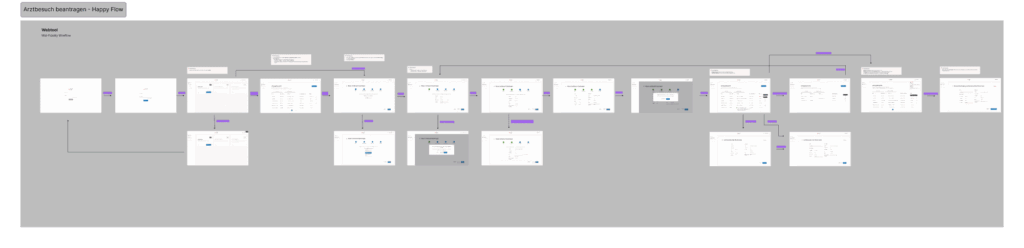
To prepare for a sales campaign, a proof of concept (POC) was developed for online requests for doctor’s appointments at hospitals.
UI Concepts for Feature Adaptations
The UI concepts served as the central operational interface between business requirements and technical implementation. The work was significantly complicated by a low level of UX maturity and the absence of a central design system. In many cases, concepts had to be developed on short notice and ad hoc based on the service specifications. The biggest challenge was integrating new features in a user-centered manner into a system that had evolved over time and already exhibited numerous usability weaknesses. Through the consistent application of established UX best practices, we nevertheless succeeded in ensuring a consistent design and intuitive usability within the complex system landscape.

Documentation & Coordination
User-Centered Documentation
Creation of structured, user-oriented documentation for the patient transport tool. Presentation of complex processes in a clear, easy-to-understand format to support the tool’s use in day-to-day operations.
PMO & Workstream Coordination
Coordination and alignment of multiple concurrent workstreams to create comprehensive software documentation. Ensuring consistent content, clear responsibilities, and adherence to time and quality requirements.
Results
- Flexibility in large-scale projects: The ability to handle multiple independent roles (QA, Design, PMO) simultaneously was crucial to the project’s success.
- Impact across depth and breadth: By focusing on key areas, improvements were achieved both in specific areas (features) and system-wide (QA, documentation).
- Holistic understanding of UX: User experience encompassed the entire spectrum here—from error-free operation (QA) to usability (UI) and comprehensibility (documentation).